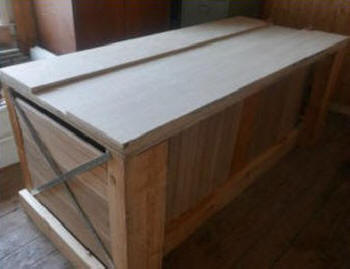
In this column: boats, design and construction, boats as a main / alternative use for versatile components
Boats: more, with some background information on flooding
Introduction
The page gives information about a 'multiple-use system with multiple-use components.' For the time being, I'm preoccupied with the practical work involved, with prototyping and other tasks. The project is well advanced, but the material on this page can't be very detailed, for a variety of reasons. Quite a number of aspects and uses are hardly mentioned or not mentioned at all.
The boats I design are very varied and very flexible. For example, the same basic boat can be propelled with oars, a sail, a punting pole or an outboard motor. The boats can be used for many different purposes, not only the important work of aiding people affected by flooding - although none of the boats can be used for sailing on the sea. This is a very recent project but I've already constructed a variety of boats in prototype form and the functions of the boat are already established. There are images of some design-constructions below. Scrolling down the page will take you to the images in this column very easily. In general, I provide fairly detailed information but not full information, for the same reasons which apply to other inventive designs. When a person who arrived at the ideas has carried out a great deal of work and reached the stage of constructions in prototype or finished form, financing this work, then the person is entitled to protect the work from being copied until the decision is reached to release much fuller information.
On this page, in this column, I concentrate on one particular application, assistance for people affected by flooding, or potentially affected. These are boats which aren't propelled - although they can be propelled if they are used for other purposes, after simple modications. They are moored outside a building or near to a building on dry land. Their purpose is to shelter people who have had to leave a building threatened by flooding or already flooded and to protect as much of their property as possible from water damage. The boats are cheap and simple, with only the equipment needed for this purpose, with no need for the elaborate equipment and features of other boats. Boats not intended for flooding relief, or used for flooding relief and then used for other purposes, have additional equipment, such as rowlocks if the boat is to be propelled by rowing, a mast and sails if the boat is to be used as a sailing boat, safety rails around the perimeter of the deck area. Installation of equipment has been made very easy, but the information as to how this is achieved isn't provided here.
If the area is flooded, then the boat floats as the flood waters rise. These boats are designed to help people at risk of flooding and people affected by flooding, to aid their general wellbeing, to provide help in protecting a proportion of their property from water damage, to shelter them whilst waiting for rescue or waiting to go back to their property after the flood waters have receded.
These boats are all quick and easy to build, from components which can be used for many other purposes, for example, in the garden, for container gardening and protected cropping, to build raised beds or raised garden pools and for garden furniture, When a boat isn't needed, the components can be put to good use. None of the components are large or heavy but quite large boats can be built, as well as very small ones. If the owner has a small boat but would like a larger one, then more of the same components are obtained and more components are used. The prototypes I've already constructed are small boats but, using the same components and the same construction methods, much larger boats can be built, capable of saving a car or a small van from the flood water.
I think it was the experience of rowing on Derwentwater in Cumbria in the autumn of this year which led me to this work on boats as a way of helping people affected by flooding.
In more detail
If a property is at severe risk of flooding, the kind which allows a return to the property quite soon or the kind which makes it impossible to live there for months, then it would be very useful to have available a boat - not to sail away from the property but simply to occupy the boat whilst the flood waters do their damage, minor or serious, a boat which can easily store household possessions in bulk, bedding, clothes, smaller articles of furniture, possessions which have great personal value, a boat which can shelter the occupants (and any pets) from the rain until they are rescued or until the water recedes. Later, the people on the boat go back to the house, the same day or after a long delay. It would be very useful if the people at the property could drive their vehicle, if they have one, onto a much larger boat, which would float when the flood waters rise, a vehicle which could be driven away when the flood waters have receded.
Is this practical? Can people who live in properties endangered by flooding actually own their own boat - a boat which achieves these ends? It's completely impractical in the vast majority of cases, if standard boats are used. The inflatable boats commonly used in flood operations are very useful, of course, but can't achieve all these objectives.
This system, however, allows boats to be quickly constructed using components which aren't very large and aren't heavy, components which can be easily stored in a relatively compact form or used in many different projects - components which are cost effective and very versatile. The boat may never be used - the components may never be assembled to make a boat - but the knowledge that a boat will be available if it ever becomes necessary is likely to be very reassuring. In fact, there are many and varied boats which can be constructed and used, sharing the same basic design features.
Use of this boat system during flooding
In concise summary: the boat will not generally be used to move people or possessions away from the flooding site, which would be a dangerous activity in fast-flowing flood water. The boat is assembled from the components after a flood warning. The boat takes about half an hour to an hour to assemble. None of the components are very heavy or very large. This includes the larch beams which are part of this system. These are not long (I give reasons above for not providing information, such as specifications, in detail in many cases) but are used to build boats which are larger or very much larger - including boats which can carry a car, putting the car out of harm's water for the duration of the flooding. These larger boats resemble rafts.
The system is very flexible, then. Larch beams float, obviously, and have the structural strength to carry heavy loads. The boats also incorporate plastic storage containers. These can be used for temporary storage of such items as clothing and bedding but the containers also act as buoyancy chambers for the boat.
Electric heaters can be brought and stored on the
boat. If the flood damage is minor, then the heaters may be able to dry out
the ground floor rooms of the flooded property in time. If the flood damage to
the ground floor is more severe but not extreme, then the heaters, along
with other items stored temporarily on the boats, can be used in the upper
area whilst this area is occupied.
When flooding is a possibility, perhaps a strong possibility, the boat is constructed from the useful components and is anchored near to the property, using a heavy duty ground anchor or by attachment to a strong and reliable fixing, e.g. part of a building. The advice often given is to take possessions upstairs, where they will be unaffected by flood water. Carrying larger possessions upstairs is difficult and can even be dangerous. The possessions chosen are moved outside to the boat. If a vehicle has been driven up the ramp and onto a large raft-boat, possessions can be placed in the vehicle.
Shelter facilities are provided on the boat to protect from the rain the people using the boat if there is no vehicle on board. These shelters are formed from curved polycarbonate sheet, which can withstand strong winds. These sheets are also very useful components. They can be used, for example, for protected growing, as mini-greenhouses. They can be used as water-collecting surfaces to divert rainwater to water storage containers and water storage ponds. I've designed many structures which make use of these polycarbonate sheets, including a water storage pond with polycarbonate sides, together with pond liner and underlay.
When water levels begin to rise, the people (and any pets they have) go to the boat. As the water level rises still higher, the people and their possessions are lifted with the boat. They may be rescued by the emergency services - the boat provides a much more convenient way of reaching them than is generally available at the moment. Alternatively, they may choose to wait until the water recedes and the boat settles on the ground. The possessions, which can obviously include very expensive, highly valued, very important items, can be placed in secure storage if the building will be uninhabitable for a lengthy period. If a vehicle has been protected by the boat, it can be used to take the possessions to the storage place.
The boat can be disassembled as quickly and easily as it was assembled. Very large raft-boats could act as the base for 'portakabins' (which could serve as temporary accommodation for the people unable to live in the house). Small portakabins could be self-built, making use of the larch beams used in the boat. During flooding, they would rise and fall with the rising and falling of the flood water. Obviously, a system has to be devised for flexible connection of the service pipes, e.g.water pipes and electrical wiring connected to the portable building.
I envisage the main use of the boat in case of flooding as static use. Very, very often, occupants of flooded houses are much better off outside the house than inside. The ground floor may well be converted into a hideous mess, the mess including quite possibly sewage. The advice to go upstairs and wait for the flood to subside may or may not be good advice in the circumstances. If people choose to go outside, then this system is designed to support them. If there's severe flooding of the ground floor, then it's certain that they won't be able to live in the property until the damage is made good. In that case, they will have to live in alternative accommodation for quite a long time.
The flat surface or surfaces of this boat system provide a low-level workbench. Higher workbenches are described in the column to the right. A portable work bench of quite some size can be erected on the base. The workbench makes the work far easier for people carrying out the task of boarding up flooded properties. They will be able to put their hand tools and power tools and storage boxes, the materials needed for boarding up, on this smooth, clean surface rather than the ground area next to flooded properties, which would almost certainly have contain debris. There will be space for storage boxes for these tools.
This is from an Internet Summary Guide to the issues:
Properties damaged by flooding are boarded up to provide a fast, temporary solution to prevent further harm from the elements or intruders, secure the structure, and ensure safety. This process involves covering openings like doors and windows with materials such as plywood or steel, often by a professional boarding-up service. It is a critical step for insurance compliance and helps manage health hazards like mould by enabling controlled drying and remediation.
Why Boarding Up is essential After a Flood [I would add: 'and should be carried out as quickly as possible, whilst the area is still flooded, in fact.]
Security: Floodwaters can dislodge doors, shatter windows and weaken frames, creating easy entry points for thieves. Boarding provides immediate protection against unauthorized access.
Secondary damage: A damaged property envelope is vulnerable to rain, wind and debris, which can cause further, costly damage to the interior and structure.
...
Structural Integrity: Temporary boarding can offer support to weakened areas, helping to prevent further collapse until permanent repairs can be made.
Insurance Compliance: Most insurance policies require property owners to take reasonable steps to prevent further loss after a flood. Boarding up is a key way to meet this obligation, which is crucial for a successful insurance claim.
The people who carry out this work of boarding up can get to properties at a very early stage, in fact, whilst there is still flood water, if they use a form of propelled flood-boat. These mobile, propelled flood-boats can be used by other people when it becomes clear that it's safe to use a boat of this kind - no fast-flowing water. The boats are flat-bottomed and so can be used in shallow or very shallow water. Punting and rowing and propulsion by means of an outboard motor are practical methods, but not use of a sail.
Flood water which is intrinsically unsafe is destructive. It can sweep away trees. cars and other vehicles. The design incorporates secure anchorage components, such as heavy chain, to ensure that the boat used in 'static mode' not 'mobile mode' stays where it is.
Boats of this design (usually of the longer length) would make perfectly good tug boats in mobile mode when equipped with an outboard engine. A tug boat could tow a line of these emergency boats to a location where temporary storage facilities (and perhaps the temporary accommodation) is provided. Fork lift trucks to transfer loads on the boats to buildings or other facilities where these would be stored.
The boat's width and length can be increased, and the buoyancy / flotation components can be easily augmented to make support and transport of heavy loads possible. The boat shown below has two distinct sections. When the structure is used for water storage, an Intermediate Bulk Container (IBC) commonly used for water storage (I have an IBC for this purpose) can fit on the structure easily. The structure is designed to take an IBC, or more than one. During flooding, water
uncontaminated by sewage or other material may not readily available, and a supply of clean water may well be needed.
The structure shown below can easily be doubled in total length. Other multiples are possible. The largest boats in this design can easily be disassembled and in general, they use the same components as the smaller boats.
The second boat shown here, the 'boatlet' is shown during construction, in my main workshop, and is smaller than the boat already outdoors. The images show variations in the design, forming a series of 'preliminary prototypes.' All of these have one layer of larch beams, with four beams in the single row. The larger boat has two layers, with five beams in each layer. Both version are shown without the base layer, of rigid, heavy duty
plastic. The base layer is essential for overall support and the provision of attachment points. Not shown in any of the images are steel bars which play an indispensable part in maintaining the structural integrity of the whole. Like all the components, these steel bars are easily carried to and from the place where the boat is assembled and disassembled.
In mobile form, the boat can be used in other situations, for example, pleasurable uses. The design makes provision of rowlocks for rowing, seating for rowing, seating for other purposes, a clear level area when the boat is moved by punting, provision of supports for installation of an outboard motor, provision of safety rails, installation of a mast to support a sail, to convert the boat into a sailing boat. There are many other possibilities. Ease of use is a feature of the design, including easy installation of all these features. The safety rails will necessarily be fitted when young children are on the boat.
Whatever use is made of the boat, the importance of safety must be stressed, safety in lifting and moving and use of tools, and in particular, the importance of safety on the water. Wearing a life jacket (or buoyancy aid in the case of good
swimmers) is essential.
The boat can only make a subsidiary contribution to lessening the serious consequences of major flooding but it can help. Before flood waters cause damage to the ground floor of a property,
some furniture, a very wide range of other goods, can be transferred to the boat. Ramps and hoists and winches can achieve movement even of very heavy objects. I've designed a combination hoist-winch for moving heavy objects, such as heavy furniture, onto the boat. On the boat, shelter from rain is provided, for people as well as goods, by means of one or more curved polycarbonate sheets.
The boat can contribute to the welfare of pets, which can be moved to the boat in
transportation cages. A wide range of clothing, bedding and other materials can be transferred and kept dry. This may well be helpful in the difficult times which lie ahead, when the
household is living in temporary accommodation. The barrels used for storage of water can be used for storage of clothes and bedding and other (light) things, once their interior has been dried.
The contents of the barrels will aid buoyancy, to counteract the downward force of heavy loads in other parts of the boat.
Accessories taken onto the boats can be very varied, including ones which can increase comfort and provide some sense of well-being. A small portable barbeque can be placed on a flat surface of the boat, if sufficiently far from any flammable materials. It can provide hot food and boiling water for hot drinks. A camping stove can also be used, but won't provide the same level of sensory satisfaction. A bench can seat many more people, but folding comfortable chairs, including reclining chairs, can be used. If the boat has to be used at night, then these chairs, with a camping mattress, or a camping mattress laid on the deck, will ensure comfortable conditions. Duvets or sleeping bags or blankets will obviously be needed for sleeping.
I live on a hill which can never be affected by
flooding but the valley of the River Don is very near, as well as two
smaller river valleys, of the Rivers Loxley and Rivelin. Water from these
rivers enter
the River Don a short distance from my house. Low-lying areas
near here have been badly flooded in fairly recent times. Flood protection
since then has been successful. In 1864, the Loxley and Don were subject to
very severe flooding which killed at least 240 people. This, the 'Great
Sheffield Flood,' was caused by the collapse of a reservoir rather than
prolonged precipitation.
Below, photos of a smaller prototype boat, the 'boatlet,' during construction. As with all the boats of this design, a very wide range of configurations and additional equipment is possible.
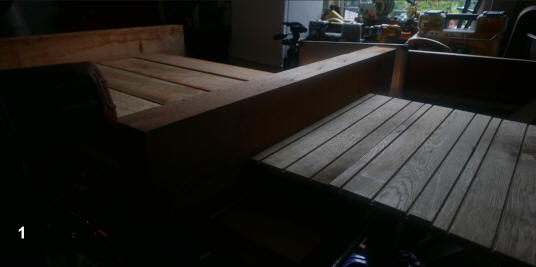
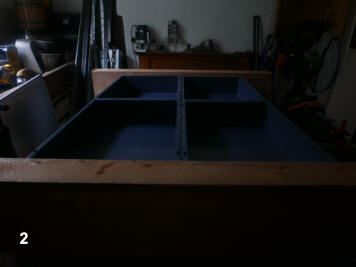
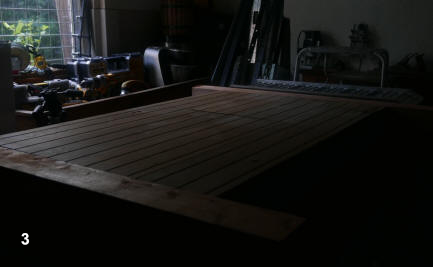
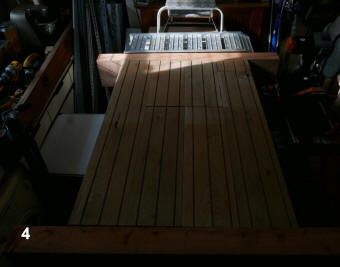
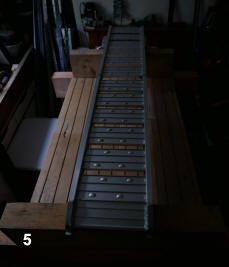
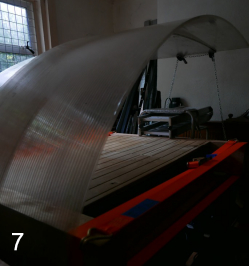
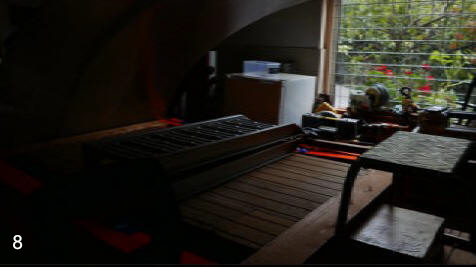
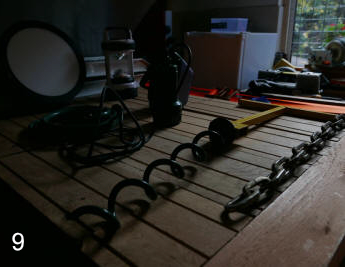
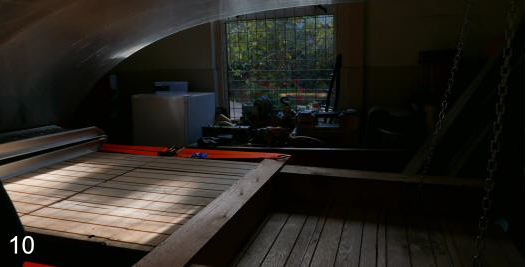
Image 1 here shows that the layer above the base layer is made up of two flat areas separated by one of the two tranverse larch beams - in this version of the prototype. Other versions are without this fature. The other transverse beam forms part of the transom of the boat. The area to the left, between the two larch beams, is made up of of four longitudinal larch beams. The area to the right is made up of oak components supported by a structure which includes structural steel. Only this image gives an impression of the size of the flat area to the right, even though not all of it is shown. In the other Images here, this area is hidden by a transverse beam. In Images 3 and 4, objects placed on the supporting / supported structure can be seen.
Image 2 shows the flat area on the right in Image 1, now equipped with storage containers of strong, rigid plastic. Possible contents include buoyancy material.
Image 3 shows the storage containers now covered by the same oak components visible on the right of Image 1. The flat area on the right in Image 1 now has two aluminium components. The long flat component is an aluminium folding ramp. When opened and moved, this gives a means of
bringing heavy objects on to the boat and removing them. It can carry a maximum load of 350kg. The ramp has smooth and rough sections. The rough sections give a suitably secure means for people to get to the boat. The smooth sections make it easier to move heavy objects on to the boat. The taller aluminium structure can be used for various
purposes, including seating and as a step to help people to get on to the boat. There are many, many other ways in which the two flat areas can be used. One possible use is to support the loads 'piled very high' discussed above, in cases where movement of the boat is subject to restriction by the operator, when the only movement allowed is
movement upwards and downwards caused by the flood water rising or falling.
Image 4 gives another view of the larger multi-purpose flat layer and the aluminium components.
Image 5 is the only image here which shows the length of the boatlet. The other images show smaller sections, although (1) gives quite an extensive view. The image shows the ramp unfolded and supported by two additional larch beams. The design makes provision for making these beams secure and unable to move as soon as they are put in position.
Other additions to the structure are secured by the same or different means. The ramp can now be used as a bench. It will seat four people sitting side by side and one person, at the far end of the bench, facing forwards and sitting either astraddle or in a more usual position. The bench as shown is very low and uncomfortable. The height and the comfort level can be increased very much by adding a layer of cushioning material, rectangular and shaped to fit the ramp / seating support. There are many other ways of arranging seating.
[Image 6 is omitted in this version]
Image 7 shows the curved polycarbonate shelter - in one arrangement. Its varying height can be adjusted and it can moved to the opposite end of the boat, so that the higher end faces in the opposite direction.
Image 8 shows a similar view but here, the folded metal ramp which is stored towards the bows of the boat in Image 7 is placed transversely. When fixed in place, by a method not described here, and given a layer of suitable material to raise its height and provide a degree of comfort, it can act as an effective rowing seat, when the boat is in mobile mode. Rowlocks and oars are amongst the things provided too, of course.
Image 9. Assorted useful items in connection with
the boatlet, items within four broad bands, from left to right. Two battery
powered lamps. The circular lamp can be used as a headlamp for the boatlet. Parts of a
powerful battery-powered water pump. Very valuable too when boats of this
design are used for a different function, as water collecting
and conservation / growing units. The water can be pumped from the storage
vessel inside the unit to a larger container or a water storage pond. When
used in the boat, it can
pump water ballast and pump drinking water from a storage container. Ground
anchor with yellow turning handle. This is a medium duty anchor. Much
heavier anchors are
readily available. Heavy duty chain, for use as anchorage when the boat is
afloat, used for security purposes on dry land. The chain will prevent the
boat from floating away if flood waters ever do encroach. At other times,
the chain can be used to prevent theft of valuable items. It would prevent
theft of the entire boat by thieves possessing the resources to make the attempt.
Image 10. The area of oak panelling prominent here is not, of course, the same as the area of panelling to the right of the ramp in Image8. This area was shown in Image 1 but is concealed in most of the images. This area is now edged at the sides with beams - only one of the beams is visible.
This is an area which would provide standing room for a punter, or space for a comfortable chair, or space for stacking loads. When the system is used for purposes unconnected with linking, there are a large number of other uses. For example, it can be used for container gardening. When the upper surface is cleared, the whole area can be used as a viewing platform - in my experience, a very interesting way of viewing a garden. In this system, the bow of the boat can become the stern and the stern can become the bow. A punter standing in the area shown in this image would propel the boat to the left. A punter standing at the opposite end would propel the boat to the right. In this case, the curved polycarbonate could not be used in the position shown in these images, but the polycarbonate sheets can easily be relocated. In another configuration of the boat, an alternative bow can be added. The 'standard' bow is square, as used in many boat designs, including punts. A V-shaped bow can be attached, or other shapes, which will have advantages in certain water conditions.
On the boat, shelter will often be a necessity.
The time spent on the boat may be a time of incessant rainfall, or of snow,
sleet, hail. My favoured method of providing shelter in many or most
projects is by means of polycarbonate sheets bent into curves.
Polycarbonate and other means of providing shelter have the difficulty that
they can act as sails, leading to unintended movements of the boat. The
situation is very much better in the case of the static configuration, the
boat kept in place not by an anchor of the kind used by boats and ships but
by a very wide range of methods, which I don't list here. Many of these
depend upon the support given by more or less large, even massive
structures, such as anchorage points set into walls, or the anchorage
provided by strong ground anchors. In these cases, the boat shelter can be
'wind-proofed,' but the exact method will be site-specific to an extent,
taking advantage of the particular features of the site, installed
advantages as well as pre-existing advantages.
The use of polycarbonate sheets as sails would be
a fruitful area for trials and testing. The position of the curved
polycarbonate sheets can be altered by rotation around an axis, the degree
of curvature can be adjusted, strongly or slightly curved. Polycarbonate
sheets can be removed and stored or put to alternative uses if windless
conditions
persist. Obviously, large sails constructed of polycarbonate are out of the
question but for small boats, they may well be not just practicable but
genuinely useful.
If this system is found useful (and it's intended to provide a wide range of advantages, not only advantages in helping the victims of floods) then these advantages can transcend the local level, relevant, I would think, at the national and international level. The advantages of the system include water collecting and water storage. A period of prolonged, torrential rain may well be followed by a prolonged drought. The arrival of rain to end the drought before an emergency becomes an outright disaster can never be guaranteed.
Certainly, far, far more can be done to mitigate drought in this country and so many others. The use of mains water for uses which don't require mains water in the least, such as watering garden plants, should become more and more uncommon. Methods of purification are available to make water collected in these ways safe for drinking and safe for use in cooking, if purification is required for water used in cooking.
Boats: more, with some background material on flooding
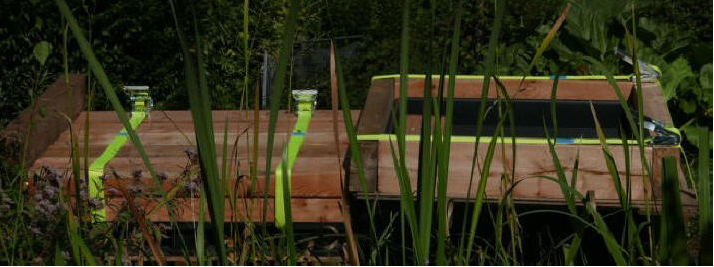
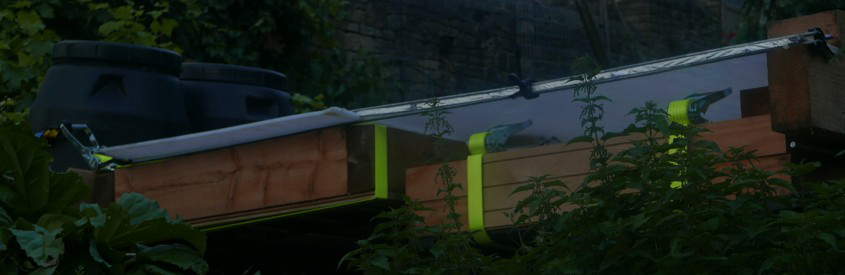
Above, two photos of a completed boat, in modified form, in two different configurations, put to an alternative use.
The stage reached: prototyping to extend the basic structure and to produce new variants. The variants belong to one of two classes: (1) structures made up of a single unit, dimensions not specified her, with substantial advantages, not specified here. (2) structures made up of two or more linked units. In general, the 2-unit structure would be used.
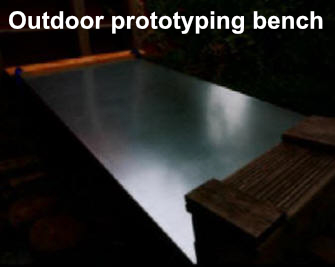
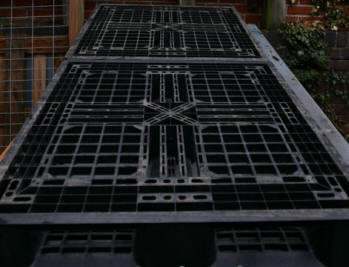
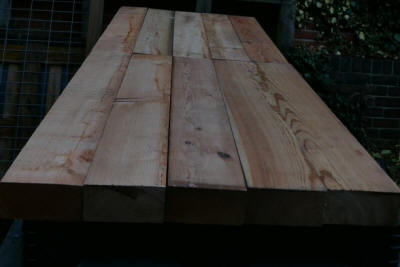
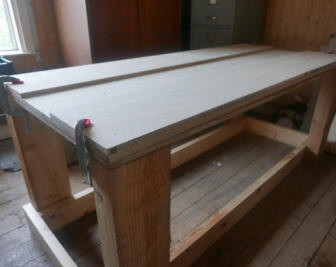
Prototyping will be concerned with a wide range of structural features. One focus of attention will be the structural steel bars which form part of the structure and which act as rigid linkages between units in class (2). I've already carried out a great deal of work on this aspect - in fact, the boat structures shown in all the images on this page, and the Home Page, are structures which incorporate these structural steel bars. The bars are enclosed in the structures and aren't visible in any of the images. The outside prototyping bench I designed and constructed has been set aside for this new phase in prototyping. The bench is large enough to hold two single unit boats or a double unit boat, which makes use of two linked smaller units.
These steel bars aren't exceptions to a basic principle underlying this design: none of the components are very heavy. They can all be easily moved. None of the components are longer than the length of 1 unit, with the exception of these steel bars and polycarbonate sheets, when used for shelter and general protection.
The boats to be used for flood mitigation would differ appreciably from the boats shown on this page and would generally be larger, often much larger, but the system used would be the same. The second photograph here shows a boat with two barrels nearby. These are for water storage - the structure is being used as a water conservation / storage unit in gardening rather than the role of boat. As I point out in the column to the left, the components used to construct the boats in this system can be used to construct many other useful things. When a boat isn't needed - and the hope is that a boat is never needed for flooding assistance - then the components can be put to good use.
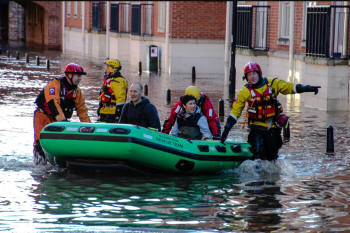
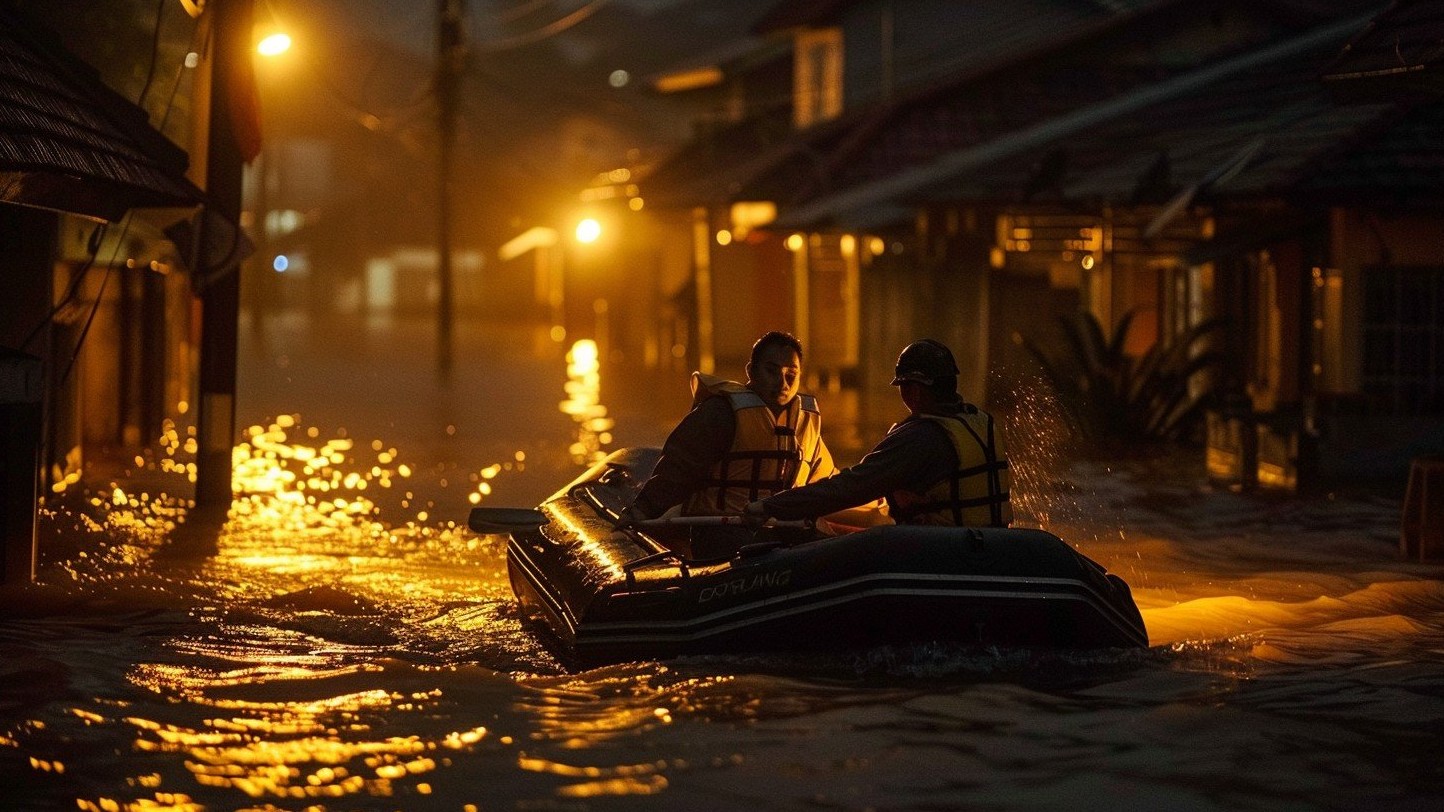
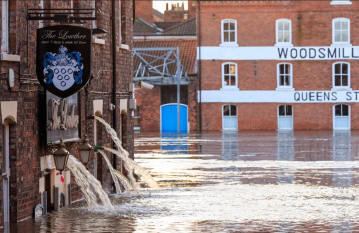

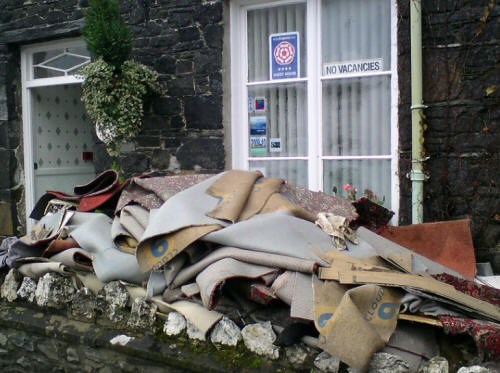
The first image in the group above shows the rescue of people affected by the severe flooding of 2015 in York. The second image conveys an impression of flooding as catastrophe in lurid light. This is followed by another image of the York flooding and an image of a stricken car, location unknown. In the fourth image, the property is in Keswick and the flood water came from the River Greta, a tributary of the River Derwent..
Inflatable dinghies are obviously important in rescue work in flooded areas. Dinghies do have some disadvantages. Rescue work may well take place in rainy conditions, perhaps in conditions of torrential rain. Dinghies provide no shelter from the rain and next to no provision for people's possessions, the kind which are bulky and heavy.
This boat, one of a series of boats of very similar design, but larger and smaller, with a range of advantages, can all be quickly fitted with curved polycarbonate sheets to protect the people and the possessions taken on board, the possessions not protected by storage containers on the boat. The boat can accommodate much larger and heavier possessions than a dinghy. It will often be possible to include possessions which are regarded as irreplaceable, ones which an insurance policy can't realistically replace.
This project - I refer to my designs, prototypes and finished constructions as 'projects' - does have important implications for flood insurance and flood insurers, I believe, if it comes to be widely adopted. I believe it has the potential to be widely adopted, more than that, it deserves to be widely adopted.
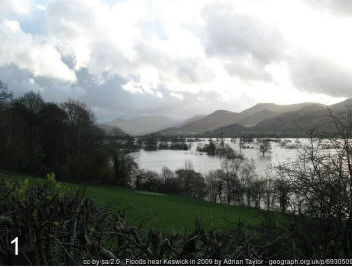
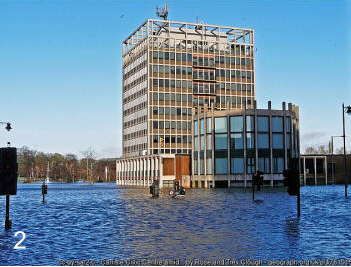
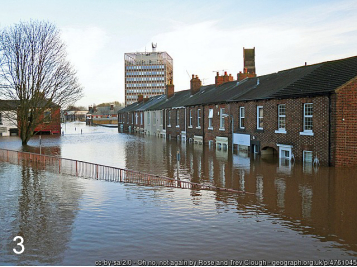
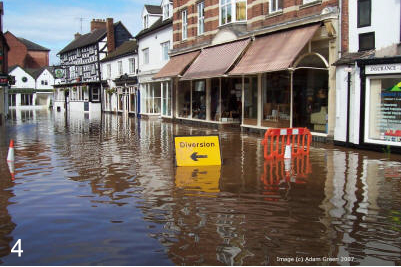
Image 1. The Keswick area, including the Keswick
campsite, was one of many areas in this country badly affected by flooding
in November 2009. Derwentwater and Bassenthwaite
lake, usually widely separated, became one body of water.
Image 2. Flooding in Carlisle, Cumbria, 2015, The Civic Centre. A storm brought gusts of wind up to 130 km/hour and torrential rain, resulting in the worst flooding for 600 years.
Carlisle had been badly affected by flooding in 2005 and millions of pounds had been spent on flood defences.
Image 3. Shows flooding in another part of Carlisle, Cumbria, 2015. During the flooding of 2005, people in the bedrooms of houses in Carlisle had been rescued by boats.
Image 4. Flooding in Tenbury Wells, Worcestershire, 2000.
The massive increase in flood risk
The information in this section comes from the Guardian article, 'Towns may have to be abandoned due to floods with millions more homes in Great Britain at risk.'
Extracts:
'Every constituency projected to be at greater risk, with many areas likely to be uninsurable ...'
'New analysis from the insurance industry ... reveals the extent of concern in the sector.' The article identifies densely populated areas including London, Manchester
and parts of north-east England as areas of particular concern.
'Tenbury Wells, a market town in Worcestershire, has become the first in the country to find that its public buildings are uninsurable. The town has historically suffered
damaging floods about once a decade, but in the past six years people there have been hit four times.
'Over the past decade, 110,000 new homes were built in the highest risk flood zones, equivalent to one in 13 of the new homes built. Aviva [an insurance company which
has produced a report on the rising flood risk] calculates that if this trend were to continue, 115,000 of the government's planned 1.5m new homes would also be in the
highest-risk flood zones.'
Flood defences which protect an appreciable number of properties are very expensive to construct but can work very well. An opinion which is pessimistic:
'Dr Jess Neumann, associate professor of hydrology at the University of Reading, said, 'We can't keep building defences taller ... to deal with larger and more frequent floods.'
t